October 2026     Edition 193
Common Sense, Intuition, and Critical Thinking
Where Mistakes are Made
Announcements

Next Critical Thinking Open Enrollment   One day workshop in two half days,
June 28/29
Follow us on Linkedin and Twitter

Most leaders don

’

t fail from a lack of intelligence.

They fail from a category error: using the wrong mental tool for the situation at hand.  We often treat common sense, intuition, and critical thinking as interchangeable synonyms for

“

being smart.

”

In reality, they are distinct instruments. The most underrated executive skill isn

’t mastering them,  but knowing which one to choose and when to switch.


Know Your Mode


  • Common Sense

    (

    “

    Don

    ’

    t reinvent the wheel

    ”

    ). The baseline shared knowledge that says don't touch a hot stove or don

    ’

    t share your password with strangers.  It

    ’

    s fast, but local. What

    ’s obvious in Silicon Valley can be nonsense in heavy manufacturing.


  • Intuition

    (

    “

    I have a bad feeling about this

    ”): Subconscious pattern recognition built on experience. A gut feel.  An ER nurse senses a patient slipping before vitals drop; a seasoned VP feels a candidate is wrong during an interview. It thrives in fast-feedback environments, but in uncharted territory, gut feelings are just biased guesses.


  • Critical Thinking

    (

    “

    Trust, but verify.

    ”

    ): Your analytical filter, slower and deliberate. It asks: What

    ’

    s the evidence? What are we assuming? What would prove us wrong? It

    ’

    s essential for complex problems but use it intentionally; you can

    ’t run a root-cause analysis on every routine email.


In cognitive science terms, common Sense and Intuition tend to fall into System 1 thinking, while Critical Thinking resides in System 2.  System 1 and 2 thinking were popularized by Daniel Kahneman (Thinking Fast and Slow).


The Executive Layer: Judgment and Wisdom


Judgment and wisdom sit above the other three and decide how to use them.


  • Judgment

    is about tool selection. It determines which mode is appropriate for the circumstances.   You don

    ’

    t use critical thinking to stop a young child running out into the street.  You shouldn

    ’t negotiate a multi-million dollar contract on gut feel.


  • Wisdom

    is like a compass. Judgment asks how to decide. Wisdom asks whether we should. It balances people impact, values, consequences, and how will this decision will look in three years, not just the next quarter?


Where Decisions Go Off the Rails: Wrong Tool, Wrong Moment


Disasters rarely happen because a tool is broken. They happen because the wrong tool is being used.


  • You make a massive financial commitment based on pure gut feel (intuition where critical thinking was needed).


  • A manager demands a 5-page ROI analysis to buy a $50 printer (critical thinking where common sense would do).


  • An executive relies on a standard playbook to navigate a crisis, assuming yesterday's rules still apply (common sense where critical thinking was required).


  • A gut decision “
    validated
    ” by a spreadsheet built backward from the answer (critical thinking in the service of intuition). This last one is the hardest to catch because it looks like rigor, but it's confirmation bias.


  • ·Dropping the ball: Intuition flags a problem but nobody then checks with analysis (critical thinking).


In every case, the wrong tool was used for the job. Great decisions pass the baton cleanly: intuition flags the anomaly, common sense frames the response, critical thinking challenges the facts, judgment picks the path, and wisdom protects the long term.


5 Questions to Audit Your Tool Selection Before You Decide:


  • What mode am I in?  Did I intentionally select this tool, or am I just defaulting to what feels easiest?


  • Is my "gut feel" backed by repeated experience? If you haven't navigated this exact pattern many times before, treat your gut as a hypothesis, not a verdict.


  • Is this a different environment?   When context shifts, the "obvious" common-sense answer is the first thing you should re-examine.


  • Am I using critical thinking to find the truth, or to justify a conclusion I've already made?  Don’t build a model to fit the desired outcome, build it to determine the outcome.


  • Is this a reversible or irreversible door? As Jeff Bezos put it: reversible decisions can run on speed and instinct. Decisions that are costly to fix  require critical thinking, no matter how confident you feel.


The Takeaway:  You

’

ll use common sense and intuition most of the time but in a situation when a mistake can be costly (time, money, relationships, health, trust, etc.), ask if those tools are applicable or you need to do a little critical thinking to

“

make sure

”

.


If you like this edition,

click here to get a Free Subscription to The Headscratcher Post.

  A monthly post with tips and techniques about problem solving, creativity, innovation and critical thinking.

PLACE HOLDER
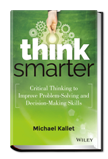
Think Smarter Book Image

Check out our Workshops

• Critical Thinking for Problem Solving and Decision Making (Core, Core+Advanced)
• Advanced Critical Thinking and Innovation
• Advanced Critical Thinking and Decision Making
• Critical Thinking for Supervisors, Managers and Leaders

Visit us at www.headscratchers.com


If you're not already a subscriber to The HeadScratcher Post,
Signup Here

Previous versions of The HeadScratcher Post
HeadScratchers

Critical Thinking Techniques for Problem Solving, Decision Making, Innovation and Leadership.
Our Mission;

To help people become better HeadScratchers! We teach critical thinking techniques to managers, leaders and individuals resulting in the improved performance of an individual and organization.